The Chair Doesn't Lie: What Happens When Men Finally Sit Still
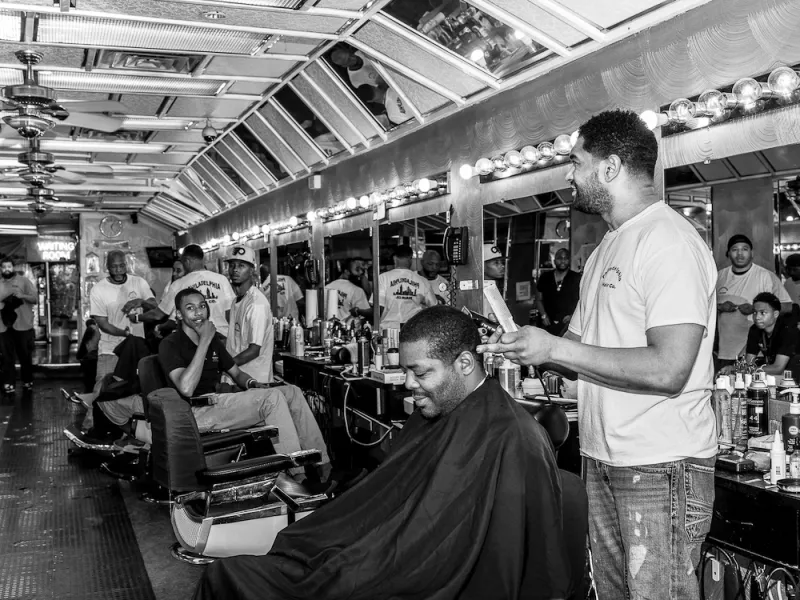
Photo: barbershop barber cutting hair neighborhood community Black barbershop interior, via hiddencityphila.org
There's a particular stillness that comes over a man the moment the cape goes around his shoulders. Something about being physically held in place — scissors close to your ear, someone else's hands near your head — seems to unlock a different kind of conversation. Not small talk, exactly. Something closer to truth.
The American barbershop has been a fixture of neighborhood life for well over a century, but its real function has never been about hair. Walk into one on a Saturday morning in any city in this country — a strip mall shop in Phoenix, a corner spot in Baltimore, a wood-paneled room in a small Tennessee town — and what you're really walking into is a community institution that runs on trust.
The Architecture of Confession
Barbers will tell you, if you ask, that the chair has a way of loosening people up. There's a theory about it: sitting down, facing your own reflection, being tended to without having to perform competence — it strips something away. The usual armor comes off with the jacket.
DeShawn Morris has been cutting hair in the same North Philadelphia shop for nineteen years. He's heard marriage proposals rehearsed out loud, sat with men who just got out of prison, and quietly talked more than a few customers through what sounded a lot like a mental health crisis. "They don't call it that," he says. "They'll say they've been stressed, or that things have been heavy. But you learn to hear what they're actually saying."
He doesn't have a therapy license. He has something arguably more accessible: a standing relationship with the same faces, week after week, year after year. He knows who just lost a job and who's about to become a grandfather. He remembers the kid who came in for his first grown-up cut before prom and now brings his own son.
That kind of accumulated knowledge is its own form of care.
Where Mentorship Gets a Haircut
In a lot of communities — particularly in Black neighborhoods across the US — the barbershop has historically played a role that goes well beyond grooming. It's been a place where older men model something for younger ones: how to carry yourself, how to speak, how to handle what life throws at you. Not through formal instruction, but through proximity and observation.
You sit and you watch. You listen to the men in the chairs before you. You absorb the room.
That informal transfer of knowledge is harder to quantify than a mentorship program, but no less real. Some researchers have started paying attention to it. Community health workers in cities like Chicago and Atlanta have partnered with barbershops to reach men who don't show up for doctor's appointments but do show up every three weeks for a fade. Blood pressure screenings. Mental health check-ins. HIV testing. The barbershop becomes the access point because the trust is already there.
It works because nobody had to build the relationship from scratch. The barber already knows you.
The Weight of Witnessing
There's a specific burden that comes with being the person a neighborhood confides in. Barbers absorb a lot. They hold information — about affairs, about financial trouble, about illness — that they carry quietly, because discretion is part of the job description even if it's never written down.
"I know things about people's lives that their closest friends don't know," says Carlos Reyes, who runs a two-chair shop in San Antonio's Westside. "And they know I'm not going to say anything. That's the whole thing. That's why they tell me."
He pauses, rubbing a clipper with a small brush. "Sometimes I think I should've been a priest."
The comparison isn't as far-fetched as it sounds. The confessional and the barber's chair share a structural similarity: a private space within a semi-public setting, a listener who won't judge, a ritual that marks time. You go regularly. You leave feeling lighter.
A Room That Holds the Neighborhood
What makes the barbershop different from other community gathering places is its consistency. Bars close. Diners get sold and turned into something else. The corner store changes ownership. But the good barbershops — the ones that have been in the same spot for a generation — become a kind of fixed point in a neighborhood's geography.
People orient themselves around them. "Two blocks past the barbershop" is a real set of directions in a lot of American cities. The shop becomes a landmark not just physically, but socially. It's where you go to find out what's happening on the block, who moved, who passed away, whose kid just graduated.
In that sense, the barber is something like a neighborhood historian. Not writing anything down, but holding the record in memory — in the accumulated weight of thousands of Saturday mornings.
The Transition Marker
Certain moments in a man's life get marked by a visit to the chair. The first real haircut before school starts. The cut before a job interview that matters. The shape-up before a funeral. The fresh fade before a wedding. These aren't incidental — they're ritualistic. Getting your hair cut is one of the few acts of physical self-preparation that men in American culture engage in openly, without apology.
And the barber is there for all of it. They watch men grow up, grow older, lose hair in the places they used to have it. They notice when someone starts going gray, when the face gets a little more tired, when the shoulders carry something new.
"I watched this one guy come in as a college kid, nervous about everything," DeShawn says. "Now he's got a business. His dad used to come here too. His dad's gone now." He lets that sit for a second. "I was at the funeral."
Why This Place Matters
In a culture that doesn't always give men a lot of permission to be uncertain or unfinished, the barbershop is quietly radical. It's a place where showing up — regularly, honestly, without a performance — is the whole point.
You don't have to have it together to get in the chair. You just have to sit still for a little while.
And sometimes, that's enough.