The Cape Goes On and the World Comes Out
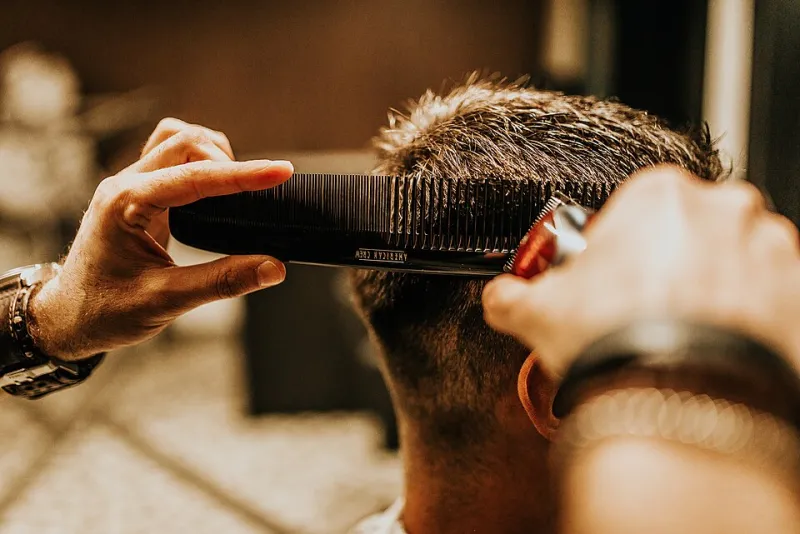
Photo: Nenad Stojkovic, CC BY 2.0, via Wikimedia Commons
The moment the cape snaps around your neck, something shifts. You're not going anywhere. Your phone is pinned under the black nylon. The mirror is right there, so you can't exactly look away from yourself either. And the person behind you — scissors in hand, eyes steady — already knows more about you than most people you'd call close friends.
This is the barbershop. And for a lot of American men, it might be the most honest place they walk into all week.
A Room With Its Own Rules
Walk into almost any barbershop in the country — a strip mall spot in suburban Ohio, a Dominican shop in Washington Heights, a old-school Black barbershop in Atlanta's West End — and you'll feel it almost immediately. The place has a temperature to it. Conversations overlap and layer. Someone's catching heat for a bad bet. Someone else is getting unsolicited advice about their relationship. A guy in the waiting chairs is laughing so hard he's holding his stomach.
It looks like chaos from the outside. But there's a social architecture to it that's been refined over a long time.
The barber is the anchor. They're the one constant in a room full of rotating characters, and they accumulate knowledge about their regulars the way a good bartender does — slowly, visit by visit, until they know the names of your kids, the rough shape of your job situation, and exactly what you mean when you say things are "fine."
"Fine" means a lot of different things in the chair.
Why the Chair Works
There's a reason therapists sometimes talk about the value of side-by-side conversation versus face-to-face. When two people aren't locked in direct eye contact, the pressure drops. You can say harder things. You can trail off without it being awkward. The chair, it turns out, is almost perfectly designed for this — you're looking at the mirror together, the barber moving around you, the conversation drifting in and out of focus as the clippers hum.
It creates permission.
For men especially, that permission is rare. American culture has never been particularly generous about giving men structured spaces to talk through what's actually going on with them. The barbershop is one of the few places that snuck through that cultural wall — probably because it doesn't look like a place for feelings. It looks like a place for a fade.
But ask any barber who's been cutting for more than a few years and they'll tell you: the job description expanded a long time ago.
The Weight Barbers Carry
Kevin, a barber who's worked the same chair in a Louisville shop for over a decade, puts it plainly. "I've had guys cry in my chair. Not often, but it happens. And when it does, I don't make a thing of it. I just keep cutting and let them talk."
He's heard about divorces in progress, kids who stopped calling, layoffs that hadn't been told to anyone at home yet. He's been the first person some of his regulars told about a cancer diagnosis. Not because he's a therapist — he's not — but because the chair was there, and the moment was right, and sometimes that's all it takes.
What's less talked about is what that costs the person behind the scissors. Barbers absorb a lot. They're not trained counselors, and there's no decompression built into their workday. You finish one client's grief and the next guy sits down talking about the Cowboys. You learn to hold things lightly and heavily at the same time.
Many barbers describe a sense of responsibility to their community that goes well beyond the technical work. Especially in Black barbershops, which have historically served as civic spaces — places where politics got argued, where elders passed things down, where young men got shaped in more ways than one — the barber's role carries a particular cultural weight. The haircut is almost secondary.
The Ritual Is the Point
There's something about regularity that makes all of this possible. You don't open up to a stranger. But every three weeks, the same chair, the same hands — that stranger becomes something else. A witness, maybe. Someone who tracks the arc of your life in small increments.
Your barber notices when you look tired. They notice when you've gained weight or lost it. They remember that you mentioned a job interview last month and they'll ask how it went without you having to bring it up. That continuity — small and consistent — is a kind of care that's hard to replicate.
In a country where a lot of people report feeling genuinely lonely, that kind of low-stakes, consistent human contact matters more than we usually admit.
What Happens When the Shop Closes
When a barbershop shuts down — and plenty have, especially through the pandemic years — the loss isn't just commercial. A neighborhood loses a gathering place. Men lose a room that was quietly doing a lot of work for them.
The ones that survive tend to survive because of exactly what can't be replicated online or at a chain salon: the relationship. The specific human being who knows how you like your taper and also knows not to ask about your brother right now.
That's not a service. That's a place.
And places like that — the ones that hold us without making a big deal about it — are worth paying attention to. Worth walking into. Worth being a regular at, even when you don't think you need a haircut.
Sometimes you do. And sometimes the haircut is just the excuse.