Spin Cycle: The Unlikely Confessions of America's All-Night Laundromats
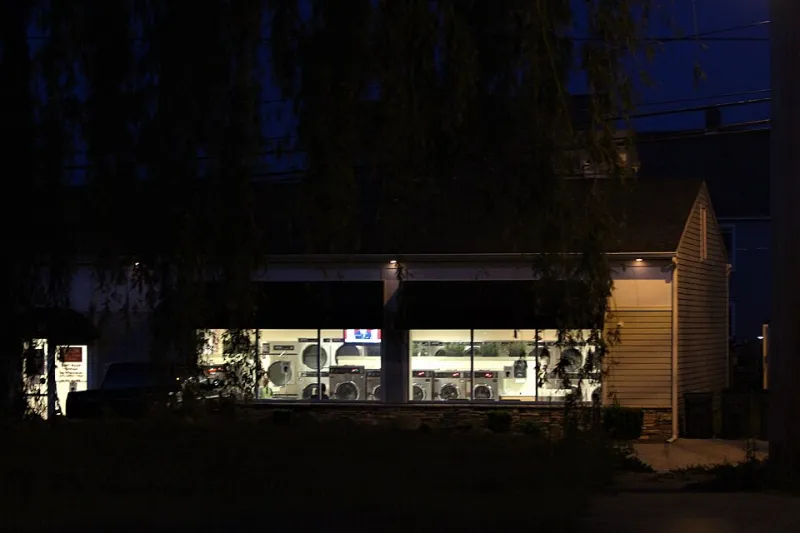
Photo: Tyler A. McNeil, CC BY-SA 4.0, via Wikimedia Commons
It's 11:47 p.m. on a Tuesday, and a woman named Graciela is sorting darks from lights at a Speed Queen in East Los Angeles. Across the row of machines, a college kid is watching YouTube with his headphones in, oblivious to everything. Near the change machine, an older man in a security guard uniform — still on, still buttoned — sits reading a folded newspaper like he has nowhere better to be. Maybe he doesn't. Maybe none of them do.
This is the laundromat. And if you've ever actually spent time in one — not just dropped off a bag, but stayed, waited, watched the drum turn — you know it's one of the last places in this country where the social performance we all put on kind of just... falls away.
The Room That Doesn't Care Who You Are
Laundromats don't have a dress code. They don't have a cover charge or a reservation system or a Yelp rating that filters out the uncomfortable parts of real life. You show up with your dirty clothes and your quarters, and that's the whole transaction. What happens after that is something else entirely.
In most American cities, our daily routines are pretty well segregated by income, neighborhood, and habit. The coffee shop you go to, the gym you belong to, the grocery store you prefer — they all send signals. They sort people. Laundromats, by contrast, are stubbornly democratic. The nurse doing a double shift, the grad student who let the hamper overflow for three weeks, the family of five from the apartment building down the street — they're all in the same room, running the same errand, waiting on the same slow machines.
That shared mundanity does something. It levels the room in a way that's hard to manufacture anywhere else.
The Unwritten Rules
Every regular knows the code, even if nobody ever said it out loud.
You don't move someone's clothes from a washer to a dryer unless you ask first — or unless it's been sitting wet for over twenty minutes and there's a clear line forming. You don't spread your stuff across three folding tables when the place is crowded. You keep your volume down after ten. You don't stare.
And yet, paradoxically, you talk. Not always. Not to everyone. But the conversations that do happen in laundromats tend to be surprisingly real. Maybe it's because you're both already doing something vulnerable — washing your clothes is intimate in a way that, say, buying coffee isn't. Your sheets are in that machine. Your kid's soccer uniform. The shirt you wore on a first date.
There's a looseness that comes with waiting. You're not in transit, not in a hurry. You've got forty minutes minimum, and your phone battery is probably at eleven percent. So you look up. You make eye contact. Sometimes you say something.
What Gets Said Between Cycles
Ask anyone who's spent a lot of time in laundromats and they'll have a story.
A woman in Chicago told me she learned her neighbor had been sleeping in her car for two weeks — she'd been coming to the laundromat every night to stay warm. "She just told me," the woman said. "Out of nowhere. We'd never even spoken before. But something about that place made it okay."
A guy in Atlanta described getting unsolicited but genuinely useful life advice from a seventy-year-old stranger who'd watched him stress-texting his ex for twenty minutes. "He didn't even introduce himself," he said, laughing. "He just said, 'Son, whatever you're doing on that phone, stop.' And he was right."
These aren't the kinds of conversations you engineer. They happen because the setting allows them to — because the room is already stripped of status markers, because you've got time, and because humans, when given the chance, tend to reach toward each other.
The Late-Night Shift
The midnight crowd is its own thing.
Daytime laundromats buzz with families, strollers, Spanish-language telenovelas playing on wall-mounted TVs, kids running between the machines. Evening brings the after-work crowd, tired and efficient. But the people who show up after eleven — they're a different category.
Some are there because it's the only time they can. Double-shift workers. Night-school students. People who share a car and only had it available late. Others come at night because the crowd is thin and the quiet is easier to bear. A few are there because they don't have much else going on, and a warm room with a little ambient noise beats a quiet apartment.
There's a specific kind of solitude that the late-night laundromat offers — not loneliness exactly, but aloneness with company. You're by yourself and you're not. The hum of the machines fills the silence. Someone else's dryer thumps steadily in the background. You're alone in the way you're alone on a long flight next to a stranger — technically together, not really talking, but somehow not entirely separate either.
What These Places Are Actually Holding
In a lot of cities, laundromats are disappearing. In-unit washers and dryers have become standard in new construction. Delivery laundry services have made inroads in denser urban markets. The economics of keeping a laundromat running — especially with aging equipment and rising utility costs — are brutal.
What gets lost when they go isn't just a place to wash clothes. It's one of the few genuinely mixed spaces left in American civic life. A place where the social sorting that happens everywhere else briefly pauses. Where a college student and a security guard and a woman named Graciela can all be in the same room, doing the same thing, with no particular hierarchy about it.
We talk a lot about community in this country — about wanting it, about losing it, about how to get it back. And usually the solutions proposed involve building something new: a community center, a public park, a mixed-use development with ground-floor retail. But some of the most genuine community infrastructure we have is already there, under fluorescent lights, open until two in the morning, charging $2.50 a load.
The Machine Keeps Turning
Graciela finishes folding around 12:30. She packs her stuff into two large IKEA bags, nods at the security guard on her way out, and heads into the parking lot. The college kid is still on his phone. The older man has moved on to the sports section.
The machines keep going. Somebody else's load is mid-cycle — whoever it belongs to will be here soon, or not. Either way, the drum turns, the water drains, and the room holds its particular kind of quiet.
Some places shape us loudly — the hometown we grew up in, the diner where everyone knew our name, the corner where something important happened. Others do it in smaller ways, almost without our noticing. The laundromat doesn't announce itself as significant. It just stays open, stays warm, and keeps offering what it's always offered: a little time, a little company, and a room where, for forty minutes at least, nobody's performing anything.