The Booth That Always Waited: Why We Keep Returning to the Restaurants of Our Childhoods
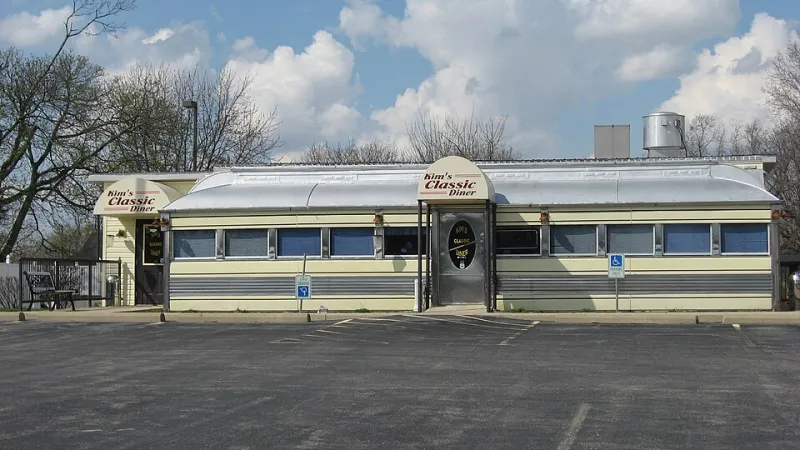
Photo: Nyttend, Public domain, via Wikimedia Commons
The sign outside Gino's East on Superior Street in Chicago still has the same blocky font it did in 1966. Inside, the wooden booths are still covered in decades of carved initials and Sharpie declarations — generations of people leaving proof they were there. Every time I visit, I find myself scanning the walls like I'm looking for something, some evidence that the place remembers me even if I can't quite find my mark.
I grew up eating deep dish there on birthdays. I haven't lived in Chicago for fifteen years. But when I'm back in town, I go. Every single time. And I'm far from alone in that particular compulsion.
More Than Just a Meal
Ask almost any American adult about their hometown restaurant — the one they'd return to first if they could — and watch what happens to their face. There's a softening. A slight pause before they answer. And then they don't just tell you the name of the place; they tell you a story. The corner booth. The jukebox. The waitress who knew their order. The smell of the place the moment you pushed through the door.
Food writers and cultural critics often talk about taste memory — the way a flavor can transport you instantly to a specific moment in the past. Marcel Proust and his madeleine, and all that. But what's happening with these childhood restaurants is something a little different, a little more architectural. It's not just the taste of the pizza or the pie that pulls people back. It's the whole physical space. The specific quality of light through those particular windows. The sound of that particular kitchen. The way the vinyl on the booth seats felt under your legs on a summer afternoon.
These places become what some researchers call "anchor points" — locations so charged with accumulated personal meaning that returning to them feels less like visiting a restaurant and more like touching a fixed point in a life that keeps moving.
The Places That Held Still
There's something quietly remarkable about a restaurant that survives long enough to become part of multiple generations of a family's life. In a country where the average independent restaurant struggles to make it past five years, the ones that endure for decades — the diners, the family-run Italian joints, the ice cream stands that have been serving the same flavors since the Eisenhower administration — become genuinely rare landmarks.
Mike and Terry's Diner in a small Ohio town near Dayton has been open since 1959. The current owner, Linda Schaefer, is the granddaughter of the original Mike. She says she regularly sees three generations of the same family come through the door — grandparents who ate there as kids, parents who brought their own children, and now those children's children ordering the same pancake special.
"People cry in here sometimes," she told me, completely matter-of-factly, while refilling coffee. "Not because anything sad happened. Just because they remember. They walk in and they remember everything all at once."
That emotional density — the way a physical space can hold so much accumulated feeling — is exactly what makes these places function as more than restaurants. They become containers for identity.
The Geography of Who We Were
Psychologists who study place attachment talk about how the spaces of our early lives don't just exist in memory — they become part of how we understand ourselves. The neighborhood you grew up in, the park where you played, the church or school or corner store that structured your days: these places shape your internal map of the world, and your sense of where you fit in it.
Restaurants, it turns out, are particularly potent nodes on that map. Unlike a house or a school, they're semi-public spaces — places where your private family life intersected with a broader community. The birthday dinners, the Friday night traditions, the post-game celebrations, the quiet lunches with a parent during a hard week: all of it happened in a space that other people also inhabited, which gives those memories a slightly different texture than purely domestic ones.
And unlike your childhood bedroom, which is almost certainly gone or transformed beyond recognition, these restaurants sometimes actually survive. Which means you can go back. You can sit in something close to the same configuration of space and light and smell, and for a moment, the distance between who you are now and who you were then collapses a little.
What We're Actually Looking For
When I talked to people about their return visits to childhood restaurants, a few themes kept emerging. One was continuity — a hunger for proof that not everything changes, that some things hold. Another was witness — a desire to be in a place that knew you before you became whoever you've become, a place with no expectations about your adult self.
And then there was something harder to name. A kind of recalibration. Several people described feeling clearer, or calmer, after a visit. Like the act of sitting in that old booth — ordering the same thing, tasting something close to the same flavor — had reset something internal. Given them a reference point.
"It's not that I want to go back to being a kid," said one woman I spoke with, who drives two hours from her home in Nashville back to her hometown in Kentucky several times a year specifically to eat at a family-owned diner where she grew up. "It's more like... I want to check in with that kid. See how far I've come. Or how far I haven't."
Why It Matters Where We Eat
Travel writing tends to celebrate the new — the undiscovered taco stand, the chef-driven bistro that just opened, the regional dish you've never tried before. And there's real value in that kind of culinary curiosity. But there's another kind of food travel that rarely gets written about: the return trip. The deliberate pilgrimage back to the familiar.
These journeys don't produce the same kind of stories — there's no discovery narrative, no first-time wonder. What they produce instead is something quieter and maybe more honest: a reckoning with how places shape us, how the spaces of our early lives continue to exert a kind of gravity long after we've left them.
The booth is still there. The coffee is still a little too strong. The pie is almost exactly as you remembered it, or close enough. And for the length of a meal, you get to be, simultaneously, everyone you've ever been in that room.
That's not nostalgia, exactly. It's more like archaeology — digging down through the layers of yourself to find the ones that were laid down right here, in this specific place, at this particular table.