Back to the Table: How Small-Town America Is Cooking Its Way Home
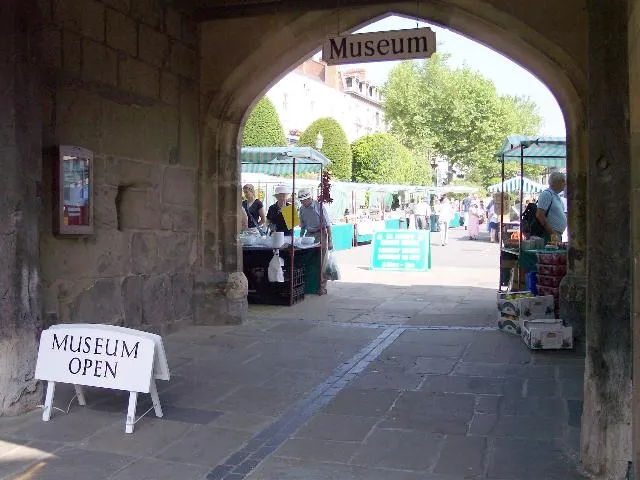
Photo: Bob Embleton, CC BY-SA 2.0, via Wikimedia Commons
There's a woman in Lewisburg, West Virginia, who makes her grandmother's apple stack cake every Saturday morning starting at five. By the time the farmers market opens at nine, she's already sold half of them. People drive forty minutes for a slice. Not because it's trendy. Because it tastes like something they almost forgot.
That's the thing about food in small-town America right now. It's becoming a kind of memory work — deliberate, urgent, and deeply tied to place.
The Chains Came. Then Something Else Did.
For a couple of decades, the story in rural communities felt pretty bleak from a culinary standpoint. Regional diners shuttered. Family-run grocers closed. Fast food filled the gap, and with it came a sameness that flattened local character. You could drive through three states and eat the same burger in the same parking lot with the same view of a highway interchange.
But something started shifting around the mid-2010s — slowly at first, then all at once. Farmers markets that had dwindled to a handful of vendors started growing again. Local food co-ops opened in towns that hadn't had one in a generation. Chefs who'd trained in cities began moving back to their hometowns, or choosing small towns intentionally, drawn by lower costs and a different kind of creative freedom.
What they found waiting for them was a pantry full of stories.
Seeds That Remember
In Anson County, North Carolina, a small nonprofit called the Uwharrie Farm Network has spent the better part of a decade tracking down heirloom crop varieties that were once common across the Piedmont region. Sweet potato cultivars. Butter beans. Varieties of field peas with names like Whippoorwill and Iron and Clay that sound like old gospel songs.
"These aren't just seeds," says Marcus Ellison, one of the network's co-founders. "They're documentation. They tell you what people ate, what the land could grow, what mattered enough to save."
Ellison grew up in the county and left for college, then spent years working in agricultural policy in D.C. before returning. He talks about food heritage the way historians talk about archives — with reverence and a real sense of urgency. "When a variety disappears, that knowledge disappears with it. The flavor disappears. The adaptation to local soil disappears. You can't just Google it back into existence."
The network now supplies seeds to a rotating group of small farms, several of which sell directly at markets or through a regional CSA program. Families who've been in the county for five generations are growing things their great-grandparents would recognize.
The New Farm-to-Table Is Actually Old
In a lot of coastal cities, farm-to-table has become a premium concept — a marketing badge that signals expense and exclusivity. In small-town America, the version taking root looks pretty different. It's less about a curated dining experience and more about logistics, relationships, and survival.
Take Rhinelander, Wisconsin, a small city in the northwoods that's been navigating economic transition for years. A group of local restaurateurs there formed an informal purchasing collective a few years back, pooling their buying power to source directly from farms within a 75-mile radius. The arrangement is loose — no contracts, just handshakes and spreadsheets — but it's kept money circulating locally in ways that matter.
"We're not trying to be fancy," says Deb Kowalczyk, who runs a supper club that's been in her family since the 1970s. "We're just trying to keep things alive. The farms, the restaurants, the whole ecosystem."
Kowalczyk's menu still features Friday fish fry and Friday night prime rib — the supper club classics that northwoods Wisconsin practically invented. But the walleye comes from a local commercial fisher now, and the vegetables come from a farm twenty minutes down the road. "Same dishes," she says, "but the story behind them is different. It means more."
Food as Community Infrastructure
What's striking, talking to people across these communities, is how often food initiatives end up doing things that have nothing to do with eating. A farmers market becomes a gathering place. A community kitchen incubator creates startup pathways for immigrant entrepreneurs. A heritage recipe project turns into an oral history archive.
In Eastman, Georgia, a small town in the agricultural flatlands of the state's interior, a group of local women launched a supper club series two years ago that rotates through members' homes. Each gathering centers on a dish with a specific history — a Gullah Geechee shrimp preparation, a version of Brunswick stew that predates the canned stuff, a sweet tea pound cake that's been in one family since Reconstruction.
The gatherings are part meal, part storytelling session. They've brought together people across racial and generational lines who, in a town of 5,000, somehow hadn't spent much time at the same table.
"Food is the thing that gets people to show up," says organizer Vivienne Tatum. "Once they're there, the conversation does the rest."
What Gets Preserved When We Cook
It would be easy to romanticize all of this — to make it sound like a simple, feel-good return to some golden era. It's more complicated than that. Heritage food movements can sometimes exclude the very communities whose traditions they celebrate. Supply chains are hard to build and easy to break. Not every small town has the population density or disposable income to sustain local food economies.
But something real is happening in these places, something that resists the kind of erasure that comes when everywhere starts to look like everywhere else. When a community fights to keep a regional dish alive, or builds a market where farmers and neighbors can see each other face to face, it's making an argument about what a place is for.
The apple stack cake in Lewisburg. The Whippoorwill peas in Anson County. The supper club walleye in Rhinelander. These aren't just foods. They're coordinates. Ways of saying: this is where we are, this is where we come from, and we're still here.
That's worth driving forty minutes for.