The Roads That Went Nowhere: What America's Forgotten Routes Still Have to Say
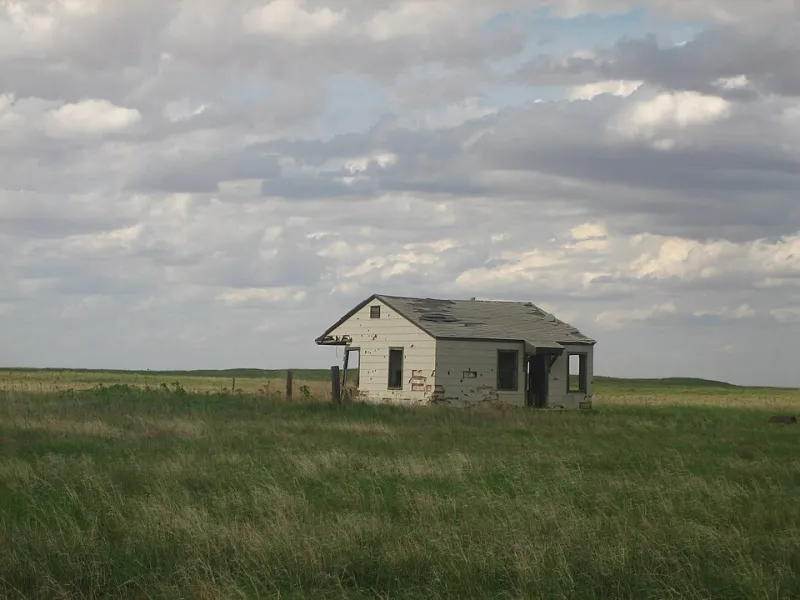
Photo: Billy Hathorn at en.wikipedia, CC BY-SA 3.0, via Wikimedia Commons
Somewhere outside of Centralia, Illinois, there's a stretch of old US Route 40 that hasn't seen regular traffic since the 1970s. The pavement is still there — barely — crumbling at the edges, interrupted by weeds that have forced their way through every available crack. A few hundred yards in either direction, the modern highway hums with trucks and commuters who have no reason to notice it.
I pulled over to look at it once, and I couldn't tell you exactly why. There was nothing to see, technically. But standing next to that broken asphalt felt like reading a sentence that someone had stopped writing mid-word.
The Country Is Full of These Places
Abandoned roads, decommissioned rail lines, shuttered Main Streets, towns that exist now only as a post office and a memory — they're everywhere once you start looking. The US has a long history of building infrastructure, watching it become obsolete, and moving on without much ceremony. The Cumberland Road. The Lincoln Highway. Thousands of rail spurs that served mining and logging operations until the resource ran out. Two-lane federal routes made redundant by the interstate system.
What gets left behind isn't nothing. It's a layered record of economic logic, political priorities, and human ambition — written in concrete and rust and the particular silence of a place that used to be loud.
When the Railroad Left
Ask anyone who grew up in a railroad town what happened when the line closed, and you'll hear variations on the same story. It wasn't just jobs that went. It was the reason the town existed in the first place.
Viola Hendricks is 78 and has lived her entire life in a small community in the Missouri Ozarks that once served as a division point on a branch line of the Frisco Railroad. The roundhouse closed in the early 1960s. The depot followed a few years later. The town, which had peaked at around 3,000 people, is now home to maybe 600.
"My father worked the railroad," she says. "My uncle. Half the men on our street. When that ended, people left looking for something else. And the ones who stayed — we just kind of watched the town rearrange itself around the absence."
That phrase — rearrange itself around the absence — stuck with me. It's an extraordinarily precise description of what happens to a place after its organizing purpose disappears. The buildings don't always fall down right away. The streets stay where they are. But the logic that held everything together quietly dissolves.
Route 66 and the Myth of the Open Road
No abandoned American road carries more cultural weight than Route 66, the old Chicago-to-Los Angeles highway that became a symbol of westward possibility before the interstates made it obsolete. The Mother Road, John Steinbeck called it. Plenty of it is still there — in fragments, in museum-piece diners, in the studied nostalgia of towns that have rebuilt their economies around the memory of the road itself.
But spend time on the actual surviving stretches of 66 — the ones that don't show up in the travel brochures — and you see something more ambivalent. In eastern New Mexico and the Texas Panhandle, the highway passes through towns that didn't survive the bypass. Boarded storefronts. Motels with their signs still standing but their rooms long emptied. Gas stations becoming abstract sculpture as their canopies slowly collapse.
These places tell a different version of the Route 66 story. Not the freedom narrative, but the one about who got left behind when the traffic moved on. The small operators who couldn't relocate. The communities that had oriented themselves toward a road that suddenly didn't matter anymore.
"The highway was the whole economy," says David Morales, who grew up in one such town and now runs a small historical preservation project documenting its decline. "When 40 opened up, it was like someone turned off a faucet. Almost overnight."
What Abandonment Reveals
There's a discipline called "ruin studies" — or more formally, urban decay research — that tries to read abandoned spaces as evidence. What does the layout of a ghost town tell you about how it was planned? What does the location of a decommissioned rail yard reveal about where capital flowed in a given era? What patterns emerge when you map the communities that lost their infrastructure versus the ones that gained new connections?
The answers aren't always comfortable. Highways, it turns out, weren't built neutrally. Urban interstates in the 1950s and '60s were often routed through Black neighborhoods with less political power to resist. Rural rail abandonment hit certain regions — Appalachia, the rural South, the Great Plains — harder than others, and those patterns correlate with poverty rates that persist today.
A forgotten road isn't just a forgotten road. It's a policy decision, made decades ago, still playing out in the lives of people who live with the consequences.
The People Who Stay
What strikes me most, driving through these places and talking to the people who remained, is how strong the attachment to place can be even when the place has been, by most economic measures, left behind.
In a small coal town in eastern Kentucky, I met a man named Gary who had turned down job offers in Cincinnati and Columbus to stay in the hollow where he was born. His reasoning wasn't sentimental, exactly — or at least he didn't frame it that way. "I know every curve of these roads," he said. "I know who's buried in every cemetery up these hollers. You can't just pick that up and move it."
That knowledge — the accumulated, embodied understanding of a specific place — is one of the things that gets lost when a community disperses. It can't be digitized or relocated. It lives in the people who carry it, and when they're gone, it's gone.
The ghost roads of America are partly about economics and infrastructure. But they're also about this: the grief of places that mattered to people, and the stubborn persistence of those people in saying so.
Still Worth Pulling Over
I keep thinking about that stretch of Route 40 outside Centralia. There was nothing to see. And yet.
Maybe that's the point. The roads that went nowhere didn't actually go nowhere — they went somewhere that we decided, for various reasons, we didn't need to go anymore. But people lived along them. Built things along them. Oriented their whole sense of the world around them.
Pulling over to look at a broken road is a small act, but it's something. It's a refusal to let a place be completely invisible just because the map has moved on.
America is full of these moments, waiting at the edge of the pavement. You just have to slow down enough to notice them.