They Watch Democracy Walk Through the Door: A Day in the Life of America's Poll Workers
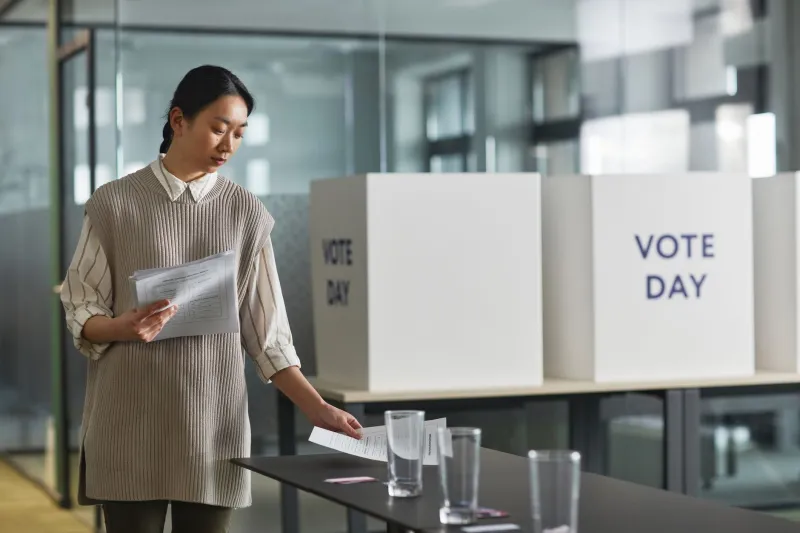
By the time most of us roll out of bed on election day, Carol Hendricks has already been at her post for two hours.
She's a precinct captain at a Lutheran church in suburban Columbus, Ohio — a role she's held for eleven years. The folding tables are up before sunrise. The "I Voted" stickers are fanned out like a little paper garden. The coffee she brought from home is already cold.
"People think election day is this big dramatic thing," she says, smoothing a wrinkle from the sign-in sheet. "And it is. But it's also just... a very long Tuesday."
Poll workers are one of the most overlooked fixtures in American civic life. Roughly 775,000 of them show up every major election cycle, staffing the gymnasiums and VFW halls and public libraries that temporarily transform into the beating heart of the democratic process. They are retirees, teachers, college students earning extra cash, and neighbors who just felt like they ought to do something. They are, in many ways, the last line of contact between an abstract ideal and a very real person standing in front of them clutching a water-stained voter registration card.
What they see across a single election day amounts to something like a compressed portrait of America — its anxieties, its humor, its grief, and its stubborn, complicated hope.
The First Hour
There's a particular kind of quiet that settles over a polling place before it opens. Workers describe it the same way, almost universally: a held breath. Machines are tested. Provisional ballot envelopes are counted. Someone inevitably realizes a supply box was left in someone else's car.
Then the doors open, and in they come.
The early voters tend to be the regulars — the ones who've been showing up to this same precinct for decades. Marcus Webb, who works a polling site in a South Side Chicago neighborhood, knows some of them by name before they reach the table.
"There's this one woman, must be in her eighties," he says. "She comes in right at six, always wearing her church hat. She told me once she's voted in every election since 1964. Every single one. I don't care what side she's on — that's just something."
Those early hours carry a certain reverence. People are quieter. More deliberate. Some dress up for it.
What Happens in the Middle of the Day
By mid-morning, the character of the room shifts. Parents arrive with strollers and toddlers who grab at the privacy screens. People on lunch breaks come in still wearing their lanyards. First-time voters — you can usually spot them, poll workers say — hang back near the entrance, scanning the room like they're trying to figure out the rules of a game nobody explained.
"The first-timers are my favorite," says Denise Okafor, a poll worker in Atlanta who started volunteering after retiring from a career in public school administration. "They're nervous. They want to do it right. Sometimes they come up afterward and ask, 'Did I do that correctly?' And I have to explain that once it goes in the machine, it's done. It counted. You did it."
She pauses. "That moment — watching that land for someone — that never gets old."
Not every moment is warm, of course. Poll workers are trained to stay neutral, to de-escalate, to hold the line on rules without becoming the face of political conflict. That is a harder job than it sounds. They field complaints about long lines, questions about why certain candidates aren't on certain ballots, and occasionally, outright confrontations from voters who arrive with grievances that have been building for years.
"You become a kind of lightning rod," says Tom Arletti, who has worked polls in rural Pennsylvania for over a decade. "People aren't always mad at you specifically. But you're there. And the stakes feel high to them. So sometimes that comes out."
He's learned to listen first. To slow things down. To find the human being underneath the frustration.
The Space Itself Does Something
There's a reason these places tend to be schools and community centers and houses of worship. The spaces carry weight. They're already embedded in people's lives — the gym where your kid plays basketball, the church where your grandmother's funeral was held. Dropping a ballot into a machine in that context feels different than clicking a button on a screen.
Poll workers notice this. They see people slow down as they walk out. Stand a little straighter. Some cry, quietly, in the parking lot. Some take photos of their "I Voted" sticker with the kind of care usually reserved for something precious.
"I've seen people come in who just lost someone," says Carol, back in Columbus. "And they'll say something like, 'My husband always voted here with me.' And they're doing it alone for the first time. That's not a small thing. That's a person carrying something enormous, and they still showed up."
The Last Hour
The final stretch of election day has its own energy — urgent, a little frantic. People who cut it close, who got off work late, who almost didn't come. Poll workers say this is when you see the voters who wrestled with the decision all day and finally decided the wrestling was worth it.
When the polls close, the count begins. It can take hours. Workers who've been on their feet since before dawn push through on adrenaline and vending machine snacks. And then, finally, the machines are sealed, the provisional envelopes are secured, and the folding tables go back into storage.
"You drive home and the radio's talking about results," Marcus says, "and you realize you were right there. You were the place where it actually happened."
That's the thing about polling places that's easy to miss when you're thinking about elections as numbers and projections and cable news chyrons. They are, at their core, physical locations where something genuinely sacred is supposed to occur — the translation of a person's convictions into a counted act.
And the people staffing those locations are witnesses to all of it. The mundane and the profound. The first-timer and the eighty-year-old in her church hat. The angry voter and the one who cries in the parking lot.
They see democracy in the room. Not as a concept. As a Tuesday.
"I don't talk about who I vote for," Carol says, gathering the last of her supplies. "That's not the point of why I'm here. I'm here because the thing needs to work. And somebody has to show up to make it work."
She tucks the sticker sheet under her arm. There are a few left over.
"Same time next year," she says, and means it.