Paper and Grief: The Walls That Hold a Town's Unfinished Stories
The flyer has been there so long that the ink has gone gray. A school photo — the kind with the mottled blue background — stares out from a corner of the post office bulletin board in a small town in central Kentucky. Below the face, a name, a height, a last known location. A phone number that may or may not still connect to anyone waiting.
Nobody took it down. Nobody moved it. It just stayed.
That's the thing about these walls. They don't forget.
The Geography of a Disappearance
Missing person posters have a life cycle that most of us never think about. Someone prints them — usually at a Walgreens or a library copy machine, sometimes a hundred copies, sometimes three hundred — and then drives a circuit around town, taping them to every surface that might hold a staple or a strip of packing tape. The post office. The laundromat. The community center lobby. The corkboard outside the dollar store.
What happens next depends entirely on the town.
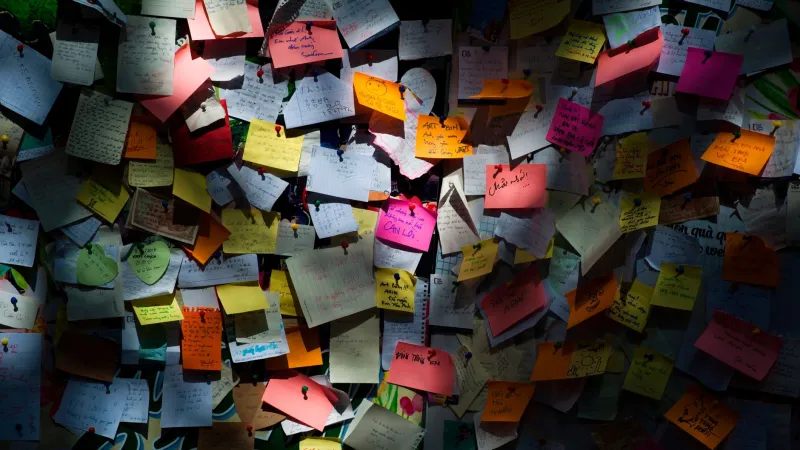
In some places, a coordinator emerges — a neighbor, a church volunteer, someone who just can't stand still when something is wrong. They make sure the flyers stay up, get refreshed when rain warps the paper, get reposted when a manager quietly clears the board for something seasonal. In other places, the posters simply accumulate, layering over older ones, until the wall becomes an accidental archive.
Linda Marsh has worked the front desk of a community recreation center in rural Georgia for going on eighteen years. She's watched the bulletin board behind her evolve from a place for swim lesson sign-ups into something harder to categorize.
"You start to know the faces," she says. "After a while, you know which ones are old and which ones are new. You notice when somebody's been up there for two years and the family is still calling to make sure the flyer is still hanging."
She pauses. "That call is the hardest part of my week, some weeks."
What the Walls Actually Say
Look at these boards long enough and you start to read them differently. The flyers aren't just announcements. They're data points in a geography of loss — and that geography has patterns.
Rural communities show up disproportionately on these walls. Not because disappearances happen more often in small towns, but because the infrastructure for response is thinner. There are fewer local news stations to run a story, fewer social media followers to amplify a post, fewer resources for families navigating a system that can feel indifferent. The bulletin board at the post office isn't a last resort. It's often the first and most reliable tool a family has.
"We didn't know what else to do," says a woman from western Tennessee whose brother went missing four years ago. She asked that her name not be used. "We printed flyers. We drove to every town within fifty miles. We asked every gas station, every diner, every place with a wall if we could put one up. That was our search."
Her brother has not been found. His flyer, she says, is still up in at least a dozen places she knows of. Probably more she doesn't.
The People Who Tend the Walls
There's an informal caretaker class that most towns don't officially acknowledge — the people who keep these boards from becoming chaos. A postmaster in rural Ohio described the quiet triage she performs every few months: checking dates, moving things that have been superseded by updates, gently reaching out to families when a flyer has gone so faded it's become illegible.
"I don't throw them away," she says firmly. "I fold them and I keep them in a drawer. Just in case."
Just in case is doing a lot of work in that sentence.
At a laundromat in a Mississippi Delta town, the owner has designated an entire section of one wall exclusively for missing persons and community emergency notices. He started it after a local teenager disappeared in 2019 and the family couldn't find anywhere consistent to post information.
"People come in here every week," he says. "Everybody in this town comes through here eventually. If something needs to be seen, this is where it goes."
He's right about the foot traffic. Laundromats are one of the great equalizers of American community life — they draw people across economic lines, across schedules, across generations. A flyer in a laundromat gets seen by people who might never read a local paper or follow a neighborhood Facebook group.
Faded but Not Gone
There's a particular quality to a flyer that has been up for a long time. The colors shift. The paper warps. The tape yellows at the corners. A face that was once sharp and present becomes something more like a memory of a face.
And yet people still stop and look.
Psychologists who study grief talk about the importance of physical markers — the ways that tangible objects anchor emotional experience to a specific place. A roadside memorial. A name carved into a tree. A photograph on a wall. These aren't just symbols. They're the places where grief lives when it has nowhere else to go.
For families still searching, these walls serve a dual purpose. They're a practical tool — someone might see the face, might remember something, might call. But they're also a declaration. We have not stopped. We have not accepted this. We are still here.
"Keeping that flyer up is the only thing I can do some days," the Tennessee woman says. "It means he's still being looked for. It means somebody might still see him and know."
What We Owe These Walls
Next time you're in a post office or a laundromat or a community center lobby, stop at the bulletin board. Really stop. Look at the faces that have been pinned there — not just the newest ones, bright and urgent, but the older ones too, the ones that have started to fade into the background of a place you visit without thinking.
These walls hold stories that don't have endings yet. They hold the specific, aching hope of families who drove a circuit around their county with a stack of copies and a roll of tape, asking strangers to hold space for someone they love.
Small towns are often described in terms of what they lack — resources, infrastructure, visibility. But there's something these communities do that larger places rarely manage: they keep the walls. They let the grief stay up. They don't rush to clear the board for the next thing.
That's not nothing. In a country that moves fast and forgets faster, the willingness to let a faded flyer stay on a post office wall for four years is its own kind of faithfulness.
The town hasn't given up. The wall is proof.