Fluorescent Light and Strangers: What Hospital Waiting Rooms Teach Us About Each Other
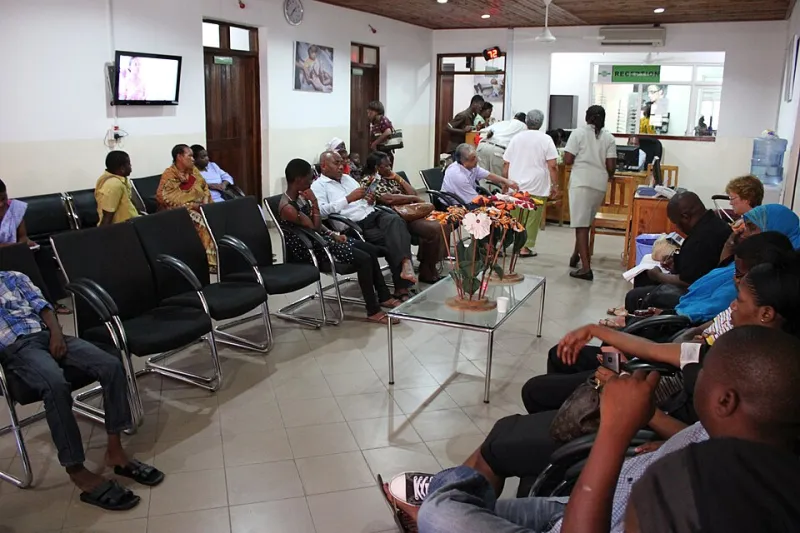
Photo: Department of Foreign Affairs and Trade, CC BY 2.0, via Wikimedia Commons
There's a particular kind of time that exists only in hospital waiting rooms. It's not quite the same as the time on your phone, or the time on the wall clock that always seems frozen at 2:47. It's slower, heavier, and somehow shared — even among people who arrived as complete strangers.
Most of us don't think of emergency rooms as places in any meaningful sense. They're thresholds. Necessary but unpleasant stops between wherever we were and wherever we're going. But spend a few hours in one — really sit with it — and something else starts to come into focus.
The Great Equalizer in Uncomfortable Chairs
Hospital waiting rooms are one of the last genuinely mixed spaces in American life. Not mixed in a curated, intentional way — not like a farmers market designed to draw a diverse crowd, or a community meeting with an agenda. Mixed in the raw, unplanned sense. The guy in the Carhartt jacket and work boots sits two seats from a woman in business attire who still has her laptop bag over her shoulder. A family that's clearly driven in from somewhere rural — kids in pajamas, a grandmother clutching a rosary — occupies a row of chairs near a college student who came in alone and keeps checking the door.
Zip codes don't matter here. Neither does the neighborhood you came from or the car you drove up in. The ER waiting room is one of the few places in America where social sorting — that constant, invisible process of like finding like — temporarily breaks down.
What replaces it is something harder to name. Call it proximity. Call it shared vulnerability. Whatever it is, it loosens people.
The Small Rituals of Waiting
Watch a waiting room long enough and you'll notice the rituals that develop, almost organically, between people who owe each other nothing.
Someone offers to grab coffee from the machine down the hall and asks if anyone else wants some. A man who's been sitting in silence for two hours suddenly starts talking to the woman beside him — not about anything important at first, just the parking, the weather, the vending machine that ate his dollar. Then, gradually, the real stuff surfaces. He's here for his dad. She's here for her sister. They don't exchange names. They don't need to.
There's a reason people talk to strangers in these rooms in ways they wouldn't on a city sidewalk or in a grocery store checkout line. Crisis compresses social distance. When life narrows down to a single waiting room and a single question — is the person I love going to be okay? — the usual armor comes off.
What the Room Remembers
Every waiting room holds layers of stories it can't tell. The worn armrests. The crayon drawing some kid left on a chair. The dried ring from a coffee cup on the side table that nobody ever moved. These rooms absorb everything and give nothing back — no plaques, no archives, no record of who sat where and what they were carrying.
And yet, the people who work in them remember. Ask any long-tenured ER nurse or hospital social worker and they'll tell you: the waiting room is its own ecosystem. Regulars exist — people managing chronic conditions, families navigating long-term illness — and they develop quiet relationships with staff and sometimes with each other. A social geography emerges that outsiders would never suspect.
In smaller towns and rural communities, this dynamic is even more pronounced. The regional hospital might be the only one for fifty miles, which means the waiting room draws from a wide radius of towns, farms, and counties. People who might never cross paths otherwise find themselves side by side, waiting on the same fluorescent clock.
The Geometry of Crisis
There's something worth paying attention to in how people physically arrange themselves in a waiting room. Early in a wait, people spread out, claim space, keep to themselves. But as time passes, the room contracts. Chairs get pulled closer. Voices drop to a register that feels communal rather than private. By hour three or four, a waiting room that arrived as a collection of isolated individuals can start to feel, however briefly, like something approaching a community.
This isn't a sentimental observation. It's a practical one. Humans under stress seek connection — with family, with friends, and when those aren't available, with whoever happens to be sitting nearby. The waiting room strips away the friction that normally prevents that from happening.
What We Carry Out
Most of us leave those rooms and never think about them again. The crisis resolves — or doesn't — and life reasserts its usual pace and distance. We go back to our neighborhoods, our routines, our carefully sorted social circles.
But something does happen in those rooms. A woman in Michigan once told me she still thinks about a man she sat next to in a Detroit ER waiting room twelve years ago. She never learned his name. They talked for maybe forty minutes while she waited for news about her mother. He was waiting on his son. When her name was finally called, she left without saying goodbye — there was no time, and she was terrified — and she's never stopped wondering how his night turned out.
That's the thing about waiting rooms. They hold moments that are too real to forget and too brief to resolve. They remind us that the country we live in is full of people in the middle of something — people we'll never meet, whose struggles run parallel to ours, whose lives intersect with ours for exactly as long as a waiting room allows.
Which might be exactly long enough.