Stamped and Filed: A Day Behind the County Clerk's Counter
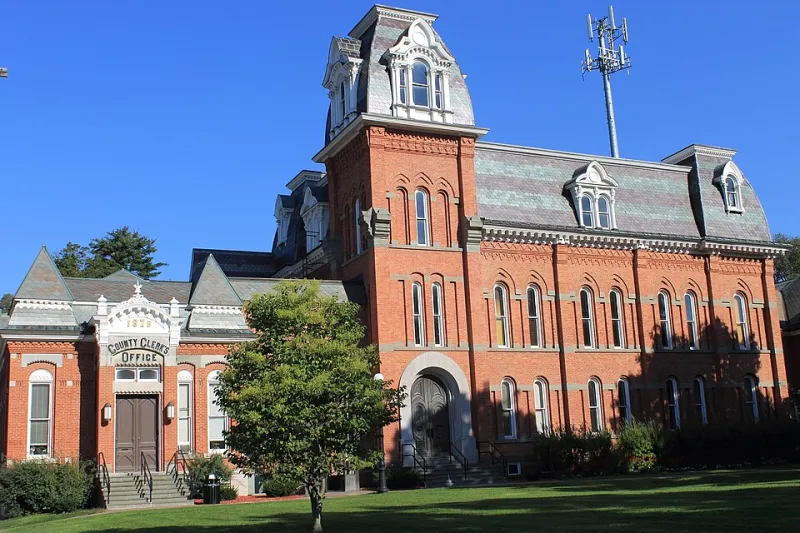
Photo: Vonsky87, CC BY-SA 3.0, via Wikimedia Commons
The clerk's office is at the end of a hallway with linoleum the color of weak coffee, past a portrait of a judge nobody under fifty can name and a glass case holding a piece of the old courthouse cornice. There is a counter. Behind the counter there is a woman named Darlene who has worked here nineteen years, and behind Darlene there is a wall, and behind the wall there is a vault.
Most people who walk into this room are having one of the biggest days of their life. Almost none of them are dressed for it.
8:06 A.M. — The First License
They come in together, early, because they think there will be a line and because they are nervous in the way people are nervous at the DMV, which is to say nervous about paperwork rather than about the thing itself. He has the wrong form of identification. She has the right one and the application filled out in careful block letters. Darlene looks at it, looks at him, and says the thing she has said a thousand times: “You're not the first, and you won't be the last. Go get the other one and come back at ten. I'll hold this.”
There is a waiting period in this state. Three days, mostly. Couples plan around it the way other people plan around a flight. Darlene has learned to read the ones who are in a hurry for good reasons and the ones who are in a hurry for reasons the three days were invented for, and she treats both with the same flat, steady courtesy.
The Wall Behind the Wall
The vault door is heavy and painted the same beige as everything else. Inside, the air is dry and the light is fluorescent and the room smells like paper that has been left alone. The deed books start in the 1870s, back when the county was still arguing with the neighboring county about where the line went. They are enormous. Some of them have bad spines. One has a coffee ring on the cover that is older than anyone's grandmother.
Every property line in town is a sentence in that room. Book 214, Page 61. A plat map from 1958 in which somebody's farm is four fields and a woodlot instead of a subdivision with cul-de-sacs named after the trees that used to be there. You can walk in off the street with nothing but a name and a rough idea of a year, and the clerk will find it for you, because that's the deal. The recording acts made this stuff public on purpose. The whole point was that a person could check whether the land they were buying actually belonged to the person selling it.
10:52 A.M. — The Deed
A woman in her seventies comes in to transfer the family farm to her nephew. She has a folder with a rubber band around it, and everything in the folder is in order, because she called ahead and asked what to bring and wrote it down. The nephew stands slightly behind her and doesn't say much. Darlene reads the legal description out loud — metes and bounds, a dogleg around a creek, a stone that used to be a marker and is now a post — and then the stamp comes down, and a hundred and some years of a family's life acquires a new page number.
On the way out the woman says, “My father bought that ground in 1961,” and Darlene says, “I know. I pulled the book.”
Notary, Witness, and Whatever Else Is Needed
People picture a clerk's day as marriage licenses and nothing else. In fact the counter handles a stranger spread than that. A man in a work jacket needs his discharge papers recorded — most states do it free, and he doesn't know that, and it takes him a minute. A nineteen-year-old is filing a fictitious business name for a lawn service and has clearly rehearsed the whole speech in the truck. Someone wants a notary signature on a title transfer, five dollars, cash or check, no card.
And then there are the death certificates. Family members come in for certified copies, usually within a week, sometimes still holding the funeral home's folder. They ask for six copies because the bank wants one and the insurance wants one and Social Security wants one and nobody tells you ahead of time how many institutions need proof that a person is gone. Darlene prints them. She does not hurry. She has learned that the small pause while the printer warms up is sometimes the only space a person gets all day.
The Quiet Hour
By early afternoon the counter empties and the work turns inward: indexing, scanning, the mechanical business of making sure that what happened today can be found in fifty years. The date stamp sits on the desk, a small metal wheel with the month and day on it, and somebody has to remember to roll it forward every morning. There's a certain satisfaction in that, if you're the type. Most of the people who work here are the type.
The clerk is an elected position in a lot of American counties. That means the person behind the counter answers to the voters, which is either a strange way or the only sensible way to run an office whose entire job is remembering.
4:47 P.M. — The Last Stamp
The building gets quiet. The hallway outside dims. Darlene rolls the date wheel forward to tomorrow, squares the stack of applications, and locks the vault. Somewhere behind that door is a page with today's date on it, holding a marriage, a farm, a business, a death, and the fact that all four happened in the same small county on the same ordinary Tuesday and were written down by the same steady hand.