Coffee, 3 AM, No Questions Asked: The All-Night Diner as America's Last Open Door
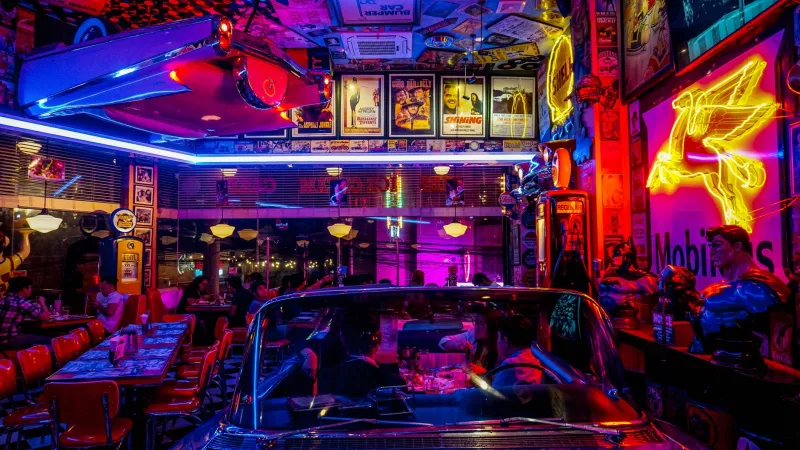
There's a particular quality to the light inside a diner at 3 in the morning. It's not flattering. It's not soft. It hums at a frequency that makes everything look a little too honest — the worn laminate tabletops, the sugar packets someone left in a pile, the half-eaten slice of pie going slow under a glass dome. And yet, somehow, people keep coming back to sit inside it.
Not because the food is extraordinary. Not because the coffee is anything to write home about. They come back because the door is open, and because nobody inside is going to ask them why.
The Only Place Still Running
Across the country — from the chrome-sided diners tucked into New Jersey highway exits to the Waffle Houses anchoring Southern interstate off-ramps to the independent spots holding down corners in cities that never fully sleep — there exists an informal network of all-night establishments that have quietly become something the country doesn't have a clean word for.
They are not shelters. They are not therapy offices. They are not churches, though some of what happens inside them edges close to confession.
They are just places that stayed open.
And in a country where so much of public life has retreated behind closed hours and reservation systems and velvet ropes of one kind or another, that simple fact — that the door is unlocked, that a person can walk in at any hour and be handed a menu — carries a weight that's easy to underestimate until you're the one who needs it.
Who's Actually in the Booth at 2 AM
Spend a few late nights inside any all-night diner and a pattern starts to emerge. There are the obvious regulars: the nurses and overnight warehouse workers fueling up before or after a shift, the cab and rideshare drivers on break, the college students cramming or celebrating or recovering from one or the other.
But there are others, too. The man in the corner booth who has been nursing the same cup of coffee for ninety minutes and staring at nothing in particular. The young woman who came in crying and has since composed herself, but whose eyes still carry it. The older couple who don't speak to each other but seem, somehow, deeply at ease in the silence. The guy who clearly just needed somewhere to be that wasn't wherever he was before.
Diners at this hour are a self-selecting crowd. Nobody ends up there by accident. You go because you can't sleep, or you don't want to go home, or you have nowhere to go, or you just need to be somewhere that feels like the world hasn't entirely shut down on you.
The unspoken agreement is that nobody pries. You eat, you drink your coffee, you take up your booth for as long as you need it, and you leave when you're ready. The social contract is minimal and, for many people, that's exactly the point.
The Waitress Who's Heard Everything
If the diner is an unconventional sanctuary, then the overnight waitstaff are its accidental clergy.
This is not a role anyone applies for. It comes with the shift. Work enough late nights and you will inevitably find yourself listening to things people don't say out loud in daylight — the rough patch in a marriage, the job that just ended, the phone call that changed everything. You learn to read the room. You learn when to refill the coffee and say nothing, and when to refill it and say just enough.
There's a particular skill in that — in being present without being intrusive, in offering warmth without demanding reciprocity. The best overnight diner workers have it in abundance, often without having been taught it formally or paid anywhere near enough for it.
Regulars notice. They come back not just for the food but for the specific person who remembers how they take their eggs, who catches their eye when they walk in and gives a nod that says, yeah, we're open, you're fine, sit wherever.
That nod is doing more work than it looks like.
The Architecture of Acceptance
There's something about the physical design of the classic American diner that seems built, almost accidentally, for this kind of gathering. The long counter with its swivel stools is designed for solitary people who don't want to feel entirely alone. The booths offer privacy without isolation. The layout puts you in the same room as strangers without requiring you to interact with them — you can be alone together, which is sometimes exactly what's needed.
The menu, too, is part of it. Diner food is deliberately unfussy. It doesn't ask anything of you culturally or financially. Eggs are eggs. Toast is toast. The pancakes are enormous and cost less than a cocktail anywhere that stays open later would charge you just to walk in. There's something quietly democratic about that — about a space that anyone can afford to occupy, at any hour, without explanation.
The 24-Hour Diner as Cultural Artifact
It's worth noting that not every community has access to one of these places. As independent diners have closed and chains have consolidated hours, the all-night option has become spottier, particularly in rural areas and smaller cities. The Waffle House footprint, for all its cultural ubiquity in the South and parts of the Midwest, doesn't cover the country. In plenty of places, there simply isn't a door that stays open through the night.
Which makes the ones that remain feel more essential than ever. They are filling a gap that no one officially designated them to fill — functioning as a kind of informal infrastructure for the hours when everything else goes dark.
FEMA, in a moment that became something of a cultural footnote, reportedly uses Waffle House availability as an informal gauge of disaster severity in affected areas. When a Waffle House closes, things are genuinely bad. The implication being: as long as it's open, some version of normalcy persists. That's a lot of symbolic freight for a place that just sells waffles.
What the Light Is Actually Doing
Maybe that's why the fluorescent glow of a diner at 3 AM doesn't feel harsh so much as honest. It's not trying to make you look better than you are. It's not flattering the moment. It's just light, steady and indifferent, falling on whoever walked through the door and decided to stay for a while.
There's a kind of relief in that. In a culture that puts enormous pressure on curating how you appear — to employers, to dates, to followers, to the general ambient judgment of everyone watching — the all-night diner offers a space where the performance can drop. You can look exactly as rough as you feel. You can sit there in your coat and not take it off. You can order just coffee and stay as long as you need to.
Nobody's keeping score. The coffee will be refilled. The door will stay open.
And sometimes, in the particular loneliness of the American night, that's the whole thing.