Bright Lights, Nowhere to Be: The Late-Night Gas Station and the People Who Find Each Other There
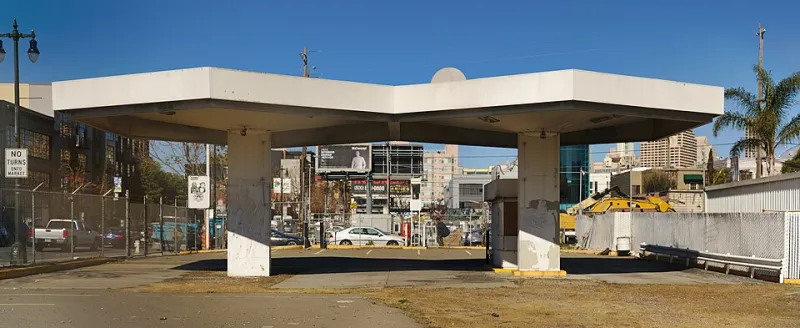
Photo: Dllu, CC BY-SA 4.0, via Wikimedia Commons
There's a specific quality to the light outside a gas station at eleven-thirty at night. It doesn't so much illuminate the parking lot as it defends against the dark — a buzzing, bluish insistence that something here is open, something here is still going. From a distance, driving through a stretch of highway that hasn't offered anything for twenty miles, that light is almost beautiful.
Up close, it's something else. It's ordinary in the best possible way.
The Hours Nobody Plans For
Most of what happens at a late-night gas station is unplanned. Nobody circles the date on the calendar and thinks, Tuesday, 11 PM, I'll be at the Shell on Route 40. You end up there because the tank is low, because you needed to get out of the house, because the drive that was supposed to end two hours ago is still going. The gas station at that hour is a place you arrive at rather than a place you choose.
And yet something about the arrival feels, briefly, like relief.
The automatic doors slide open. The refrigerated air hits you. Somewhere in the back, a mop bucket rolls across linoleum. The woman behind the counter doesn't look up immediately, and that's fine — there's no performance required here, no cheerful greeting you have to match. You can be exactly as tired or wired or aimless as you actually are.
For a certain slice of American life — the shift workers coming off a double, the insomniacs who gave up on sleep around ten, the college students mid-road trip who've run out of both gas and conversation — the late-night convenience store is one of the few public spaces that asks nothing of you emotionally. It's open. It's lit. It doesn't care what you look like or why you're there.
A Taxonomy of the 11 PM Crowd
Spend enough late nights on American roads and you start to recognize the types. Not in a reductive way — more the way you recognize constellations. Patterns that appear, reliably, in the dark.
There's the long-haul driver who parks the rig at the far edge of the lot and walks in stiffly, already knowing what he wants, already calculating how many hours until the next stop. There's the young woman who pulls up in a car full of bags and sits in the driver's seat for a full three minutes before coming inside, and you don't know her story but you recognize the posture — she's gathering herself for whatever comes next.
There's the local who clearly comes here every night, who has a specific brand of energy drink and a specific spot near the door and a nod of recognition with the overnight cashier that contains about six months of accumulated small talk compressed into a single gesture. There's the family — two parents and a kid who should be asleep but isn't — running on vacation adrenaline and bad planning, the child pressed against the glass of the hot food display like it's a museum exhibit.
None of them are there for the same reason. All of them are there.
The Cashier Who Holds the Room Together
The overnight cashier is the most underwritten figure in American life. They are there when the rest of the country has opted out of consciousness, and they are steady in a way that the hour makes remarkable.
In Albuquerque, there's a man named Ernesto who has worked the overnight shift at the same Pilot station for eleven years. He knows the regulars by their cars. He knows which truckers are running behind schedule because they come in faster, skip the coffee, go straight for the energy drinks. He has, over the years, called 911 for a woman who came in crying and didn't want to explain why, talked a lost tourist through directions to three different motels, and let a teenager sit in the store for two hours at 2 AM without asking any questions because the kid clearly needed somewhere to be.
"People think this job is boring," he says, leaning against the counter during a slow stretch. "But every night is different. You just have to pay attention."
Paying attention, it turns out, is its own form of hospitality.
What Liminal Spaces Tell Us
Sociologists have a term — liminal space — for places that exist between defined states. The airport terminal. The hospital corridor. The waiting room. These are places where the usual rules of social interaction loosen slightly, where strangers make eye contact more readily, where the ordinary defenses come down just enough to let something real happen.
The late-night gas station is one of America's most democratic liminal spaces. It doesn't sort by income or neighborhood the way most places quietly do. The man in the pickup and the woman in the Lexus are standing at the same coffee station, both squinting at the label on the hazelnut creamer, both just trying to make it to wherever they're going.
That accidental equality is rarer than it should be. Most American spaces are segregated — not always by law or intention, but by price point, by geography, by the invisible sorting mechanisms of daily life. The gas station at midnight doesn't have time for those distinctions. It's just open.
The Particular Comfort of a Place That Stays Lit
There's a reason people who've been through hard stretches talk about the late-night gas station with a specific kind of affection. Not nostalgia exactly — more like gratitude for a thing that was there when you needed it and didn't make a big deal about it.
The night your relationship ended and you drove for two hours without knowing where you were going. The morning after the hospital visit when you needed gas and a cup of something hot and a few minutes of being somewhere that wasn't there. The cross-country move where the last hour of driving felt impossible until the lights of a truck stop appeared on the horizon like a very small, very practical miracle.
These places don't know they matter. They're not trying to. They're just open.
And sometimes, at eleven PM on a Tuesday when everything feels a little unmoored and the dark outside is thick and the road ahead is long, that is genuinely enough.