Three O'Clock at the Counter: The Most Honest Lender in America Isn't a Bank
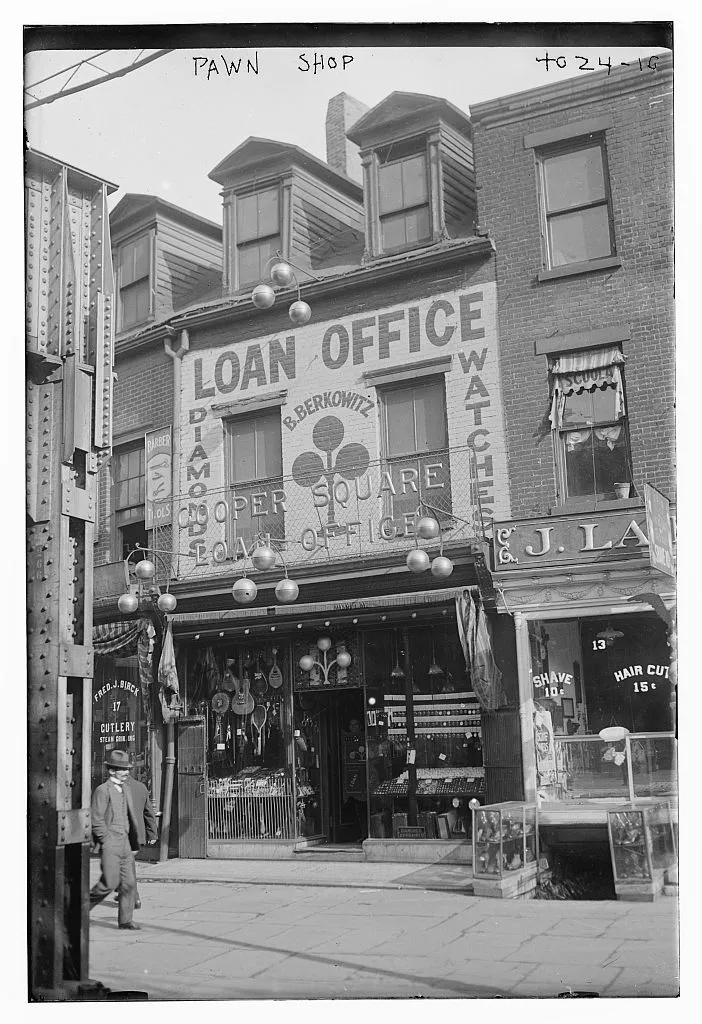
Photo: The Library of Congress, Public domain, via Wikimedia Commons
There's a moment, about twenty minutes before closing, when the pawn shop settles into its truest self. The afternoon rush of people pawning tools before a shift or buying back a guitar on payday has passed. What's left is the day's last customer, sliding something across the glass counter, and the broker turning it over under the lamp with the patience of a jeweler and the poker face of a cardiologist.
I've spent time in pawn shops in three states, and I've come to a conclusion that will sound like provocation but is, I believe, simply true: the pawn shop is the most honest financial institution in America.
The Deal Happens in Plain Sight
Compare the alternatives. A bank lends against your credit score, a three-digit abstraction computed by companies you've never dealt with, for reasons no one can fully explain to you. A payday lender buries a 400% APR in font size designed by someone who should be ashamed. A credit card company changes terms in an envelope you throw away unopened.
The pawnbroker hands you money against a physical object, in cash, today, with one number attached and no number hidden behind it. If you don't come back in the agreed window, the shop keeps the item. That's the entire arrangement. No collections calls. No mark on your record. No surprise. Every other lender in your life is obligated to obscure something; the pawnbroker's business model depends on you understanding exactly what's happening.
What Comes Across the Counter
The objects tell the real story of the American balance sheet. Wedding rings, more than anything — I've watched brokers handle them gently, almost apologetically, and quote the highest price their conscience allows. Tool sets from a tradesman between jobs. A grandmother's coin collection. Instruments, always instruments, because a guitar is the easiest thing to sell in hard times and the first thing bought back in good ones.
The brokers know this. The good ones — and they exist in every shop — develop a sixth sense for the difference between an object being sold and an object being surrendered. The first gets a fair price. The second gets a loan structured so the person can reclaim it, because a repeat customer who gets their ring back is worth more than a ring.
Lender, Appraiser, Sometimes Therapist
For the roughly one in five American households that are unbanked or underbanked, the pawn shop isn't a fringe institution. It's the local branch — no account required, no appointment, no judgment delivered in a formal letter. It's also, functionally, an appraisal office. People bring in an inherited watch or a dusty rifle case not to sell but to find out what they have. Try getting that from a bank.
And then there's the part nobody budgets for. Because the transaction requires a story — why the money, why now — the counter becomes a place where people say things out loud that they haven't said anywhere else. A job loss. A divorce in progress. A medical bill with a comma in it. The broker nods, does the math, and keeps the story. Discretion is part of the service, as old as the trade itself.
The Case for the Last Resort
I'm not romanticizing it. Interest on pawn loans is high. People do lose heirlooms. The industry has its predators like any other.
But honesty should be judged by the gap between what an institution does and what it tells you it does. By that measure, the pawn shop — cash on the counter, terms on a ticket, consequences stated up front — has a cleaner relationship with the truth than most of the financial system that looks down on it.
The lights go off at six. The last customer walks out with an envelope and, usually, a plan to come back. Behind the glass, the objects wait — each one a small, honest IOU, each one a story somebody intends to return for.