Eleven Quiet Months: The County Fairgrounds After the Lights Go Out
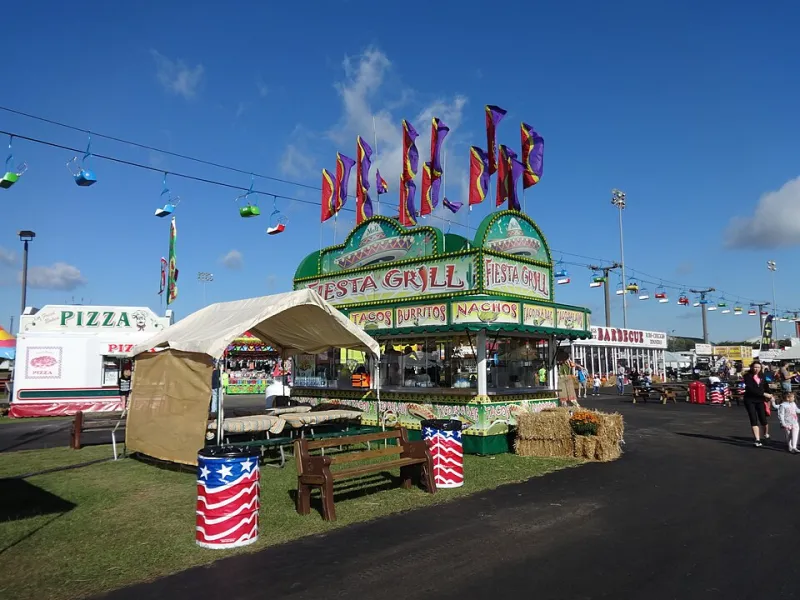
Photo: Michael Rivera, CC BY-SA 4.0, via Wikimedia Commons
The gate is open, which is the first surprise. No chain, no padlock, just a gravel drive with a rut down the middle where the snow plow gave up. In August this entrance backs up onto the highway for a mile. In February you could land a small plane on it.
The county fairgrounds cover forty-some acres of flat ground on the edge of town, and for six days a year they are the loudest place in the county. The rest of the time they are something else entirely: a set of buildings with the lights off, waiting, in a way that is very difficult to describe and impossible to miss.
The Ticket Booth Doesn't Need a Lock
The booth is the color of a faded school bus, and it has a little sliding window and a hand-painted sign listing prices from a year nobody has bothered to update. Inside, if you cup your hands to the glass, you can see a roll of tickets still on the spindle and a plastic tub of wristbands. The whole structure leans slightly. It has always leaned slightly. Nobody fixes it, because for six days a year it works fine and for the other three hundred and fifty-nine nobody looks at it.
The light in February is the thing you notice first. It's low and gray and it comes in sideways, and it makes the painted trim on the grandstand look like an old photograph of itself.
Grandstand, Population Zero
The bleachers are wood, and the wood has been carved on for a hundred years: initials, hearts, a few names that belong to grandparents now. The seats face a half-mile track that is frozen into a dull amber sheet in places and bare dirt in others. In August there will be a demolition derby here, and harness racing, and a tractor pull that produces a noise you feel in your teeth. In February there is a single crow and a length of caution tape that has come loose at one end and is snapping in the wind.
The announcer's booth is above the grandstand and its door is unlocked. There's a desk, a microphone on a swing arm, a laminated schedule, and a paper cup with a pen in it. Somebody wrote on the wall in pencil: “Do NOT let Gary near the mic before noon.” Nobody has painted over it in at least a decade. It's part of the building now.
The Barn Still Smells Like Sawdust
You'd think the smell would go. It doesn't. The beef barn is forty degrees inside, empty, and it smells like shavings and livestock and dust, and the smell is somehow not unpleasant, because it's the smell of animals that were healthy and well-kept and shown by kids in white shirts.
The stalls have name plates that slide in and out of a bracket. Most are blank in February. A few are not. One says “HOLSTEIN — K. MILLER.” One says “RESERVED” and nothing else. The tack room is locked, but the hooks outside it are not, and there are still hay strings tied to a couple of them, frayed and bleached.
The Pie Case in the Floriculture Building
This is the building that gets you. It's a long, low, whitewashed structure that in August holds the judged entries: canned peaches with little numbered tags, jars of honey, a display case of pies with the winners marked by a ribbon, and a wall of vegetables arranged by a committee with strong opinions about uniformity. There's a hand-lettered sign over the door that says FLORICULTURE & AGRICULTURAL PRODUCTS in a font someone chose in 1974.
In February the cases are empty and the tables are stacked against the wall. But the room still has a ghost of a smell in it — sweet, greasy, faintly of fry oil from the food trailers that park outside every August. It's in the ceiling. It will be in the ceiling forever.
That's the thing about a fair: the food is the part people remember with their whole bodies. Funnel cake, a pork chop sandwich from a stand run by a church, a bag of mini donuts that costs more than lunch and is worth it exactly once a year. The vendors aren't here in February. But the room has kept their perfume, which is a strange and slightly holy sort of memory.
Eleven Months of Other Business
A fairground isn't actually idle. It's rented. The 4-H clubs meet in the community hall. The fair board holds its monthly meeting in a room with a marker board and folding chairs, and spends it arguing about parking. Snowmobile clubs run the track when it freezes. There are gun shows, craft shows, a flea market the third weekend of every month, an RV storage arrangement in the back lot, a blood drive, a booster club pancake breakfast, and last spring, three wedding receptions and a training session for poll workers in the same room, in the same month.
That's the practical answer to what a fairground does the other eleven months: it holds whatever the county needs a big flat room for. It's the town's largest indoor space and its only parking lot that can absorb four hundred cars without anybody complaining.
Where the Town Keeps Its August
But that's not really why people slow down when they drive past it in the off-season. There's a particular kind of remembering that only works when a place is empty. Stand in the grandstand in February and you can hear the noise from last August. Walk past the empty pie case and you can taste the thing you bought on the midway eleven years ago with two dollars you had in your pocket.
A fairground is a memory palace a county builds for itself, out of plywood and paint and a few acres of gravel, and then leaves alone for most of the year so it can keep doing that. In six weeks the trucks will start arriving. Somebody will repaint the ticket booth sign with a new price. Gary will be warned about the microphone.
For now, the wind moves through the empty bleachers, the pie case holds nothing but a smell, and the county is exactly as big as its quietest week makes it.